ラベル politics の投稿を表示しています。 すべての投稿を表示

2010/05/26

Jigyo Shiwake Tweets and Amakudari

Last week, I wrote a blog post about Tweeting Jigyo-Shiwake".

As I was busy with various works, I was not able to stay home and watch Jigyo Shiwake the whole 4 days, but asked on Twitter for others to help out. I would like to thank everyone who helped, especially @MMHero who was devoting much of his time during the 4 days.

Personally, I think it is better to blog than tweet for this, since non-Japanese people would need explanation on technical terms and Japanese political custom (such as Amakudari etc) , but I think this was a good experiment.

I was watching many of the sessions and there was 1 thing that is common to most of the sessions, which is Amakudari.


Quote from wikipedia:

Amakudari (天下り) is the institutionalised practice where Japanese senior bureaucrats retire to high-profile positions in the private and public sectors. The practice is increasingly viewed as corrupt and a drag on unfastening the ties between private sector and state which prevent economic and political reforms.

Jigyo shiwake is about cost cutting, and when they try to do cost cutting on any public sector, the big chunk of money dangling in front of the shiwake-nin is the huge cost of Amakudari people.

I won't go into details here, but some of the Japanese "institutional practices" are as follows:

1) Public sectors in Japan are based on Seniority System (年功序列)

Japanese companies were based on seniority system till recently too, but the economic situation no longer allows such thing. You need outputs to get promoted in most Japanese corporate entities now. However, public sectors still have seniority system and the older you are, the higher your position (and salary) you get.

2) Japanese bureaucracy has "Career" people and "Non-Career" people (キャリアとノンキャリ)

"Career" are the people who passed higher level exam for the National Public Service(国家公務員試験の上級甲種またはI種), and are promised to be executives in the future. "Non-Career" people are people who passed the exam for National Public Service, but not with the higher level one. "Non-Career" will not be promoted above unit head. A Non-Career I met recently told me that she is really discriminated by the "Careers".

So when the Career people get old are ready to retire, they get plenty of retirement bonus from the agency, and the Seniority System and Career System secures them "posts" in public and private sectors with high salary, with not much work to do. That is how "Amakudari" works.

In most sessions of the shiwake I watched, shiwake-nin would ask how many board members they have, and how many of them are Amakudari, and how much their salary was. Each time the reply was given, Twitter chat on Ustream would go mad as their salaries are around 12 million - 16 million yen, when average salary of the citizens are male: 5.3 million and female: 2.7 million. "Fire those Amakudari and hire more younger people who does the actual work!" Twitter users say. Totally. Now that we are getting a clearer view of the cost of Amakudari, I am hoping that the Government Revitalization Unit will actually take action to abolish Amakudari. (Government Revitalization Unit is responsible for government reform as well as Jigyo Shiwake).


**FYI: Japanese Average Salary**

Data source: The National Tax Administration Agency (unit is 10,000 yen)

**Some pics and screenshots**

This is how the venue looks: view from behind the audience

photo.jpg

closer view towards the shiwake-nin

事業仕分け

view from the other side

事業仕分け

Tons of cameras on both sides

photo.jpg
photo.jpg

Hand-written shiwake results on the walls.

事業仕分け

事業仕分け

During the last Shiwake, there were criticisms that the press were getting tables (whereas others just have chairs) and some press people left their belongings to secure their seats but weren't sitting there. This time, press had a separate room where they have tables and chairs but can only watch Ustream and Nico Nico Nama Housou, and in the actual room for the Shiwake, they only had chairs just like other people.

事業仕分け

Screenshots from Ustream


Screenshots from NicoNama- some people couldn't answer the questions from Shiwake-nin and are asking folks sitting behind them.


Screenshot from Stickam. BTW, none of the streaming companies were paid by the government to do this live streaming, but they were allowed to put advertisements on their streams. So during the breaks, Stickam was actually putting various advertisements that they sold to their clients.


Ustream was using the poll function. This is a screenshot of the question about the facility that was getting shiwake. The options are 1) I have used the facility 2) I have NOT used the facility 3) what the heck is that?


And as you can imagine, only 6% replied they've been there, 36% said no and 59% didn't even know what that facility is. (And they are using enormous amount of money to construct and operate that facility using our tax... that sucks!!)


The next poll was which political party you plan to vote for the coming upper house election.


**Summary of English tweets**


2010/05/19

Tweeting "Jigyo-Shiwake"

Last month, I wrote a post about "Jigyo-Shiwake" in Japan. The next round of "Jigyo-Shiwake" will start tomorrow and will be held on 5/20,21, 24th and 25th.

Today, I was asked to come to the upper house to discuss the possibility of tweeting in English about Jigyo-Shiwake. Unfortunately tomorrow I am packed with interview, meetings and event and it is impossible for me to watch shiwake and tweet. I can probably go to the venue on Friday so I will try to tweet on that day.

If there is anyone who is able to watch live-streaming of Shiwake in Japanese and tweet in English, that would be awesome.

=================================

You will be able to watch live streaming here:
Room A in Ustream
Room B in Ustream

Room A in NicoNama
Room B in NicoNama

=================================

Please use hashtag: #sasshin_e for English tweets on jigyo-shiwake.

Personally, I will be tweeting from a separate account @fumitw from my usual account @fumi.

Not sure if anyone realized but they have photos from Picasa and videos from YouTube on the top page of Shiwake now :)

2010/04/26

"Jigyo-Shiwake" in Japan

In Japan, after the political change last summer, there were many changes in the political scene- for better or worse. One of those changes is "Jigyo Shiwake (budget-cutting panel)".

In the former LDP administration, budget creation and cutting was done internally in the government and there was no transparency for this process. After DPJ came to power, they created a new division called "Government Revitalization Unit(行政刷新会議[ja])" which holds Jigyo Shiwake to cut budgets from various governmental projects. Bureaucrats and project members explains to the politicians(Shiwake-nin) the importance of their projects to keep the budget, and Shiwake-nin decides whether that project will be able to keep the budget or not. This whole process is streamed live on the Internet.

The first Jigyo Shiwake was held last November, which was a huge success in terms of making the ruling party look very transparent. Taro Kono, LDP politician says in his blog[ja] "I went to watch Jigyo Shiwake. To be honest, I envy them for being able to do this."

In terms of decreasing the budget drastically, they were not successful. Projects that were discussed in this Jigyo Shiwake was only 15% of the total governmental projects and the amount they were able to cut was not large. Yet Shiwake was a great step towards government transparency which the LDP administration never had.

This time around- it started last Friday (4/24) and will continue until 4/28 (time table (PDF) [ja])

Yukio Edano, State Minister in charge of Administrative Reform who manages this Jigyo Shiwake giving the opening statement.


Renho- a popular DPJ politician and one of the Shiwake-nin.


A bureaucrat explaining why his project is necessary and needs budget. (Check the number of viewers- 17,222!)


In the former regime, this process was easy for the bureaucrats as the people they needed to explain were the people they knew which did not require much explanation. It was held in a private room where the general public was unable to know what was being discussed. After the political change, they need to go through this Shiwake process where they need to explain to the politicians who are not familiar to specific projects. Also the general public is watching the whole process from morning to night LIVE on Internet and they are chatting about this Shiwake the whole day using Twitter. They can't hide anything any more. Now, it is really important for those bureaucrats to learn how to make comprehensive explanations and presentations. Apparently some of them are not used to being asked and exposed, and were unable to reply to questions properly. The results are strict- for example JAXAi, a showcase of Japan Aerospace Exploration Agency(JAXA) is going to be closed because 10 out of 12 Shiwake-nin thought it was unnecessary after listening to the explanation by JAXA.

There were 5 official companies live-streaming this Shiwake on the Internet. (BTW, the government is NOT paying for the streaming.)


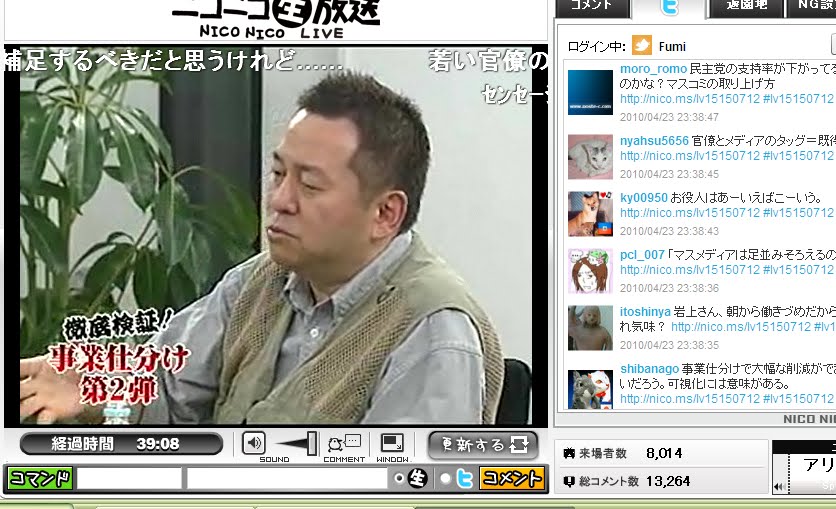
Screenshots from NicoNicoNamahousou, which had a very good quality streaming and I think they had more cameras than others (according to this article on Asahi[ja], NicoNico had 6 cameras in the venue) so they had better shots getting the Shiwake-nin, bureaucrats explaining to Shiwake-nin, and also shots with wider angle to show the atmosphere, etc.


I was also using this website called USTWRAP to watch the 2 U-stream channels (there were 2 rooms for Shiwake) simultaneously as well as watch the Twitter stream on each room.


The ministry created an excellent website[ja] that has all of the timetables, descriptions of each project, handouts, results of Shiwake, links to all of the Internet streaming channels, and Twitter stream talking about Shiwake. I was able to get all of the information necessary from this single website which is VERY rare in Japanese government websites which are usually like a maze.


Another great thing is that NicoNicoNamahousou is doing a wrap-up event each night inviting journalists to talk about the results of the Shiwake on that day.


I think this whole Shiwake process is great, and value it largely. On the other hand, it clarifies more and more of what we really need. Current Shiwake projects are more in detail. What we REALLY need for this country is a bigger and long term vision and strategy,and Shiwake should be done based on such bigger vision. Unfortunately, DPJ's Manifesto (campaign promises) does not have such vision and strategy- I am hoping such debate to be started before the upper house election this summer.


2010/04/12

Ustream and Twitter changing politics in Japan

For the long history of the Japanese media- when Japanese prime minister, ministers, local governments, police etc make press announcements, the rule was that the "press club" would take care of those press meetings. Press club consists of major newspaper publishing companies and mass media. Freelance journalists, web media, magazines, foreign media, citizen journalists etc were all excluded from those press clubs. This means that the press club and the politicians can control what would be spoken, what would be asked at the press conferences, which means that the citizen's right to know was not protected in this country- at least to a certain extent.

I wrote a lot [ja] about this old press club system and how it is changing recently on my Japanese blog. After the political change last year, the ruling party -DPJ had been pressured to keep their campaign promise to open up the press conferences.

Katsuya Okada- Minister of Foreign Affairs decided to open his press conference to a wider range of journalists, Shizuka Kamei - Minister of State for Financial Services decided to hold 2 press conferences (1 for the press club, another for other journalists including magazines, freelance, internet media etc). On 3/26, FINALLY the press conference of Prime Minister Hatoyama was opened to freelance and foreign journalists [ja] and was ustreamed.

On 3/9, Kazuhiro Haraguchi - Minister of Internal Affairs and Communications who is an active Twitter user, decided to hold his press conferences using Ustream. His announcement to hold this Ustream press conference was released only on Twitter. 1,200 people watched this 30 min long Ustream press conference which he spoke about the privatization of postal services that happened in the former Koizumi administration. After he finished his speech, he returned in front of the camera to answer directly to the comments by the viewers. The funny thing was that the PR division of the Ministry of Internal Affairs and Communications did NOT know about this event- replying to the interview by ITMedia[ja] that they are "perplexed" and that they "do not have any information about this Ustream conference".

(screenshot from Haraguchi's 4/16 Ustream)


On 3/5, LDP politician Taro Kono did a NicoNicoNamaHousou (a Japanese Ustream-ish live video broadcasting service) of his project to review the projects by the ruling party DPJ. He not only streamed the whole process but also came back in front of the camera during the break time to give a short and concise lecture on what the theme is, what the issues are, what the conclusions are, to enhance the understanding of the viewers. Kono is an active Twitter user as well.

(screenshot from Kono's NicoNama)

Japanese political system was really conservative and seemed that nothing would change- but services such as Ustream and Twitter are really changing the way we interact with politicians.


2009/06/18

Internet Usage by Politicians

Using the Internet for politicians is somewhat complicated in Japan, and they are prohibited to do things like what President Obama did with his political campaign, so this post is about that topic.


Definitions


There are 2 important terms in this matter.

Political Campaign 【選挙運動】
Political Campaign is an action to persuade to vote for specific candidate for a specific election during the election period. (特定の選挙に、特定の候補者の当選をはかること又は当選させないことを目的に投票行為を勧めること。)

In Japan, the election period is 12 days before the election for the House of Representatives and 17 days for the House of Councilors. Election period is the only period that persuasion for voting is allowed. This makes a big difference with the elections in US where you spend a long long period of time for political campaigns. The reason for this limit in the period is to minimize the cost that is required for political campaigns.

-Political Activity 【政治活動】
Political Activity is all of the political activities EXCEPT Political Campaigns.
 政治上の目的をもって行われるいっさいの活動から、選挙運動にわたる行為を除いたもの。

Internet can be used for "Political Activity", so political parties and politicians has their websites and blogs.

-Liberal Democratic Party of Japan (LDP, ruling party) website
-Democratic Party of Japan (DPJ) website

There are lots of blogs by politicians at ele-log[ja], and many others has their[ja] own[ja] blogs[ja]. Yahoo has a List of blogs by Members of the House of Representatives[ja] and a list of blogs by Members of the House of Councilors[ja].


However, Internet is prohibited to use for "Political Campaigns" based on Public Offices Election Act (公職選挙法) clause 142 which prohibits to "distribute documents, graphics and pictures" 「文書図画の頒布」 for the political campaigns. Updating websites, blogs and sending mail magazines are defined as one of these "documents, graphics and pictures".

There had been hot debates on this in the year 2005 when DPJ updated their website and sent mail magazine during the election period, LDP filed a complaint about it and the Ministry of Internal Affairs and Communications (MIC) called DPJ referring to this action as a violation of Public Offices Election Act. DPJ complained in return that LDP updated their website with news articles as well, and MIC called LDP as well. You can see some of the documents here[ja] (document from DPJ to MIC questioning the action by LDP, answer from MIC to DPJ) .


In 2007, both LDP and DPJ updated their website and neither filed any complaint so I think this issue has been taken care of in a very Japanese way- keep the grey things grey.


Some politicians were updating their podcasts saying "audio is none of the "documents, graphics and pictures" so it should be OK.


When Takafumi Horie -Ex-CEO of internet company Livedoor- became a candidate for election, Livedoor (the portal site) stopped updating[ja] political articles except the news articles that were provided from other news sources.

By the way, the Act regulates not only the political parties/politicians but EVERYONE (何人も) to "distribute documents, graphics and pictures" to "persuade voting for certain candidate on certain election", so if you are a blogger and write on your blog "hey you should vote for candidate A", then strictly speaking you are violating the Public Offices Election Act, but in reality nothing would probably happen.


NicoNicoDouga


NicoNicoDouga - a popular video sharing site in Japan - has gained interesting position with the politicians.

One day, one of the users uploaded a video of the politicians debating in the diet, and the viewers started to get interested and spread the word and started commenting on the video. It is said that the users of NicoNicoDouga are youngsters, and those generation does not watch TV, are not very interested in politics so they were the clusters that the politicians were having a hard time reaching out. But in that video, what Kazuo Shii- head of the Communist Party- was saying made a lot of sense to them, and people started to listen and support him. The Communist Party started uploading more videos after that. NicoNicoDouga has become one of the avenues for the politicians to reach out to the younger generation.

So when NicoNicoDouga started a new service called "NicoNicoChannel" where users/companies/organizations can create landing pages, political parties and politicians rushed in.

Political parties' channels (LDP, DPJ and Communist party)


Politicians' channels (Mizuho Fukushima, Yoshiro Mori, and Yuriko Koike)


Also when NicoNicoDouga started another new service called "NicoNicoNamaHousou" which is a live streaming service (like Ustream), politicians started using them too. During NicoNicoNamaHousou, viewers can write comments on the screen, and if the politicians so wish they can read the comments while streaming and reply to them (not everyone wants to do that). This is NicoNama of Ichiro Ozawa (was the head of DPJ then). Today, Kazuo Shii (head of Communist Party) was on NicoNama.


(update 6/19)
Prime Minister Taro Asou's speech in Akihabara was on NicoNama too, and you can still see the video here.

Also, LDP proposed a program to invite 200 people to visit the Parliament building and their headquarter and do a NicoNama answering their questions which attracted 5000 viewers. You can see the video here.

NicoNicoDouga has another service called NicoWariEnquete which is like online survey that can be conducted with NicoNicoDouga viewers. NicoNicoDouga did a NicoWariEnquete asking the viewers what they'd like to ask the Prime Minister. The Prime Minister took his time to answer the questions that were raised and you can see his video here.


Lots of the users of NicoNicoDouga are kids and some are very rude, and I thought politicians wouldn't like that environment as they are used to being looked up to- but so far it looks like it hasn't been a problem to them.


Changing the Public Offices Election Act


There had been lots of debates about this issue, for example DPJ issued a draft for amending the Public Offices Election Act (1998/06/18
インターネット選挙を解禁する公職選挙法改正案の提出について[ja]) to enable the use of Internet during election period back in 1998, but the situation stays the same today. Quote from the draft "By reinforcing this amendment and enabling Election Campaigns on the Internet, we can realize conversation with constituents on policies. この公職選挙法改正で、インターネットのホームページでの選挙運動が可能になることによって、政策本位の有権者との対話が実現する。"

I think this one sentence that was written back in 1998 proves they understood 2 important points. 1) to have conversation with the constituents 2) those conversations should be centered on policy.

What we learned from Obama Campaign was that he was trying to gain understanding and conversation and trying to be as interactive as possible. At the "Change Government" site, people could write expectations and ideas for Obama when he becomes the president and others could vote on those ideas, the policy team were sharing new ideas where people can write feedbacks, people could submit questions which were answered by House Press Secretary. This enabled the Obama team to understand what people wants/expects, and people could understand what Obama team was up to and give them their opinions and feedbacks, and strengthened the understanding, conversation and interaction. People were able to discuss about specific policies here.

DPJ submitted another draft[ja] to amend the Public Offices Election Act and enable the usage of Internet in 2006 for the 4th time. The Act has not changed yet- as of June 2009.


Twitter


2 Japanese politicians -Mr. Seiji Ohsaka of DPJ and Mr. Gaku Hashimoto of LDP - started using Twitter recently, and are commenting about the policy issues and/or writing about the details of what's being discussed during the diet. Seiji Ohsaka tweeted[ja] yesterday about the debate among party leaders while watching it on TV including his comments in realtime.

For example, this is one of his posts while watching the party leader debate:
First sentence is reporting what the Prime Minister said, and the second sentence with brackets is his opinion.


"(Prime Minister Aso) Not all of the budget was waste
(Of course, but you need to prove it and therefore you should publicize the details) "

7/18 Update:
On 6/30, we held a workshop on "Twitter and Politics" which I was one of the panelists with LDP politician Mr. Gaku Hashimoto, IT journalist Mr. Daisuke Tsuda and Mr. Masahiko Shoji of GLOCOM. Since then, the number of politicians that uses Twitter increased[ja] to 20 (!) and a website called "Politter"[ja] which has updates of all the Twitter-politicians' tweets.


Seiji Ohsaka submitted his questions regarding Twitter and political activities to the Ministry of Internal Affairs and posted the reply he got on his blog [ja]

(ツイッターを使用して選挙運動を行うことについて)
 公職選挙法第142条第1項は、選挙運動のために使用する文書図面について、同条に規定する通常葉書又はビラのほかは、頒布することができないと規定しています。
 コンピューター等のディスプレイ上に表示された文字等の意識の表示は文書図画に該当するものですが、同条の規定により選挙運動のために頒布することができる文書図画ではないことから、現在、お尋ねのツイッターは選挙運動のために使用することができません。


"About the usage of Twitter- Public Offices Election Act 142-1 prohibits the distribution of documents, graphics and pictures used for Political Campaigns other than postcards and leaflets that are specified in the article. Letters displayed on the computer are considered as one of those documents/graphics/pictures, and therefore Twitter cannot be used for Political Campaigns."


Twitter (and websites and weblogs and mailmagazines etc) usage for Political Campaigns are banned in Japan, but it can be used for Political Activities, and we are able to read and enjoy the opinions, comments and thoughts of some of the politicians in real-time. I think it's a big step.