2010/05/26

Jigyo Shiwake Tweets and Amakudari

Last week, I wrote a blog post about Tweeting Jigyo-Shiwake".

As I was busy with various works, I was not able to stay home and watch Jigyo Shiwake the whole 4 days, but asked on Twitter for others to help out. I would like to thank everyone who helped, especially @MMHero who was devoting much of his time during the 4 days.

Personally, I think it is better to blog than tweet for this, since non-Japanese people would need explanation on technical terms and Japanese political custom (such as Amakudari etc) , but I think this was a good experiment.

I was watching many of the sessions and there was 1 thing that is common to most of the sessions, which is Amakudari.


Quote from wikipedia:

Amakudari (天下り) is the institutionalised practice where Japanese senior bureaucrats retire to high-profile positions in the private and public sectors. The practice is increasingly viewed as corrupt and a drag on unfastening the ties between private sector and state which prevent economic and political reforms.

Jigyo shiwake is about cost cutting, and when they try to do cost cutting on any public sector, the big chunk of money dangling in front of the shiwake-nin is the huge cost of Amakudari people.

I won't go into details here, but some of the Japanese "institutional practices" are as follows:

1) Public sectors in Japan are based on Seniority System (年功序列)

Japanese companies were based on seniority system till recently too, but the economic situation no longer allows such thing. You need outputs to get promoted in most Japanese corporate entities now. However, public sectors still have seniority system and the older you are, the higher your position (and salary) you get.

2) Japanese bureaucracy has "Career" people and "Non-Career" people (キャリアとノンキャリ)

"Career" are the people who passed higher level exam for the National Public Service(国家公務員試験の上級甲種またはI種), and are promised to be executives in the future. "Non-Career" people are people who passed the exam for National Public Service, but not with the higher level one. "Non-Career" will not be promoted above unit head. A Non-Career I met recently told me that she is really discriminated by the "Careers".

So when the Career people get old are ready to retire, they get plenty of retirement bonus from the agency, and the Seniority System and Career System secures them "posts" in public and private sectors with high salary, with not much work to do. That is how "Amakudari" works.

In most sessions of the shiwake I watched, shiwake-nin would ask how many board members they have, and how many of them are Amakudari, and how much their salary was. Each time the reply was given, Twitter chat on Ustream would go mad as their salaries are around 12 million - 16 million yen, when average salary of the citizens are male: 5.3 million and female: 2.7 million. "Fire those Amakudari and hire more younger people who does the actual work!" Twitter users say. Totally. Now that we are getting a clearer view of the cost of Amakudari, I am hoping that the Government Revitalization Unit will actually take action to abolish Amakudari. (Government Revitalization Unit is responsible for government reform as well as Jigyo Shiwake).


**FYI: Japanese Average Salary**

Data source: The National Tax Administration Agency (unit is 10,000 yen)

**Some pics and screenshots**

This is how the venue looks: view from behind the audience

photo.jpg

closer view towards the shiwake-nin

事業仕分け

view from the other side

事業仕分け

Tons of cameras on both sides

photo.jpg
photo.jpg

Hand-written shiwake results on the walls.

事業仕分け

事業仕分け

During the last Shiwake, there were criticisms that the press were getting tables (whereas others just have chairs) and some press people left their belongings to secure their seats but weren't sitting there. This time, press had a separate room where they have tables and chairs but can only watch Ustream and Nico Nico Nama Housou, and in the actual room for the Shiwake, they only had chairs just like other people.

事業仕分け

Screenshots from Ustream


Screenshots from NicoNama- some people couldn't answer the questions from Shiwake-nin and are asking folks sitting behind them.


Screenshot from Stickam. BTW, none of the streaming companies were paid by the government to do this live streaming, but they were allowed to put advertisements on their streams. So during the breaks, Stickam was actually putting various advertisements that they sold to their clients.


Ustream was using the poll function. This is a screenshot of the question about the facility that was getting shiwake. The options are 1) I have used the facility 2) I have NOT used the facility 3) what the heck is that?


And as you can imagine, only 6% replied they've been there, 36% said no and 59% didn't even know what that facility is. (And they are using enormous amount of money to construct and operate that facility using our tax... that sucks!!)


The next poll was which political party you plan to vote for the coming upper house election.


**Summary of English tweets**


2010/05/19

Tweeting "Jigyo-Shiwake"

Last month, I wrote a post about "Jigyo-Shiwake" in Japan. The next round of "Jigyo-Shiwake" will start tomorrow and will be held on 5/20,21, 24th and 25th.

Today, I was asked to come to the upper house to discuss the possibility of tweeting in English about Jigyo-Shiwake. Unfortunately tomorrow I am packed with interview, meetings and event and it is impossible for me to watch shiwake and tweet. I can probably go to the venue on Friday so I will try to tweet on that day.

If there is anyone who is able to watch live-streaming of Shiwake in Japanese and tweet in English, that would be awesome.

=================================

You will be able to watch live streaming here:
Room A in Ustream
Room B in Ustream

Room A in NicoNama
Room B in NicoNama

=================================

Please use hashtag: #sasshin_e for English tweets on jigyo-shiwake.

Personally, I will be tweeting from a separate account @fumitw from my usual account @fumi.

Not sure if anyone realized but they have photos from Picasa and videos from YouTube on the top page of Shiwake now :)

2010/04/26

"Jigyo-Shiwake" in Japan

In Japan, after the political change last summer, there were many changes in the political scene- for better or worse. One of those changes is "Jigyo Shiwake (budget-cutting panel)".

In the former LDP administration, budget creation and cutting was done internally in the government and there was no transparency for this process. After DPJ came to power, they created a new division called "Government Revitalization Unit(行政刷新会議[ja])" which holds Jigyo Shiwake to cut budgets from various governmental projects. Bureaucrats and project members explains to the politicians(Shiwake-nin) the importance of their projects to keep the budget, and Shiwake-nin decides whether that project will be able to keep the budget or not. This whole process is streamed live on the Internet.

The first Jigyo Shiwake was held last November, which was a huge success in terms of making the ruling party look very transparent. Taro Kono, LDP politician says in his blog[ja] "I went to watch Jigyo Shiwake. To be honest, I envy them for being able to do this."

In terms of decreasing the budget drastically, they were not successful. Projects that were discussed in this Jigyo Shiwake was only 15% of the total governmental projects and the amount they were able to cut was not large. Yet Shiwake was a great step towards government transparency which the LDP administration never had.

This time around- it started last Friday (4/24) and will continue until 4/28 (time table (PDF) [ja])

Yukio Edano, State Minister in charge of Administrative Reform who manages this Jigyo Shiwake giving the opening statement.


Renho- a popular DPJ politician and one of the Shiwake-nin.


A bureaucrat explaining why his project is necessary and needs budget. (Check the number of viewers- 17,222!)


In the former regime, this process was easy for the bureaucrats as the people they needed to explain were the people they knew which did not require much explanation. It was held in a private room where the general public was unable to know what was being discussed. After the political change, they need to go through this Shiwake process where they need to explain to the politicians who are not familiar to specific projects. Also the general public is watching the whole process from morning to night LIVE on Internet and they are chatting about this Shiwake the whole day using Twitter. They can't hide anything any more. Now, it is really important for those bureaucrats to learn how to make comprehensive explanations and presentations. Apparently some of them are not used to being asked and exposed, and were unable to reply to questions properly. The results are strict- for example JAXAi, a showcase of Japan Aerospace Exploration Agency(JAXA) is going to be closed because 10 out of 12 Shiwake-nin thought it was unnecessary after listening to the explanation by JAXA.

There were 5 official companies live-streaming this Shiwake on the Internet. (BTW, the government is NOT paying for the streaming.)


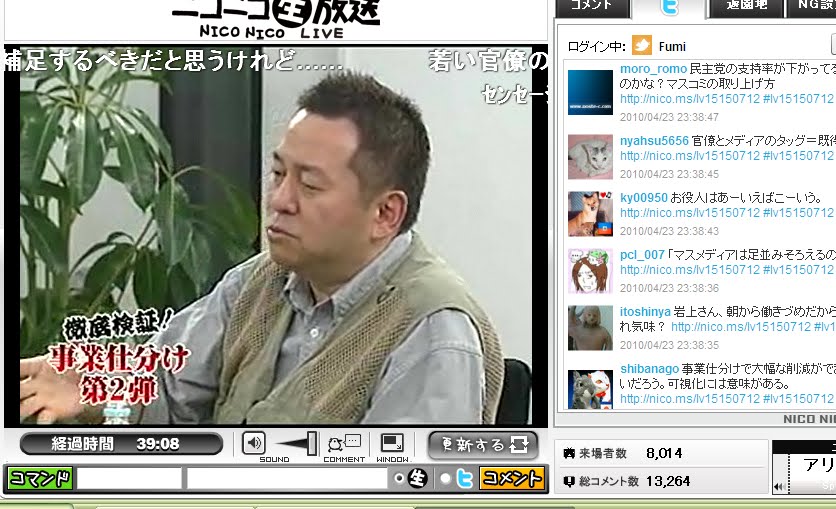
Screenshots from NicoNicoNamahousou, which had a very good quality streaming and I think they had more cameras than others (according to this article on Asahi[ja], NicoNico had 6 cameras in the venue) so they had better shots getting the Shiwake-nin, bureaucrats explaining to Shiwake-nin, and also shots with wider angle to show the atmosphere, etc.


I was also using this website called USTWRAP to watch the 2 U-stream channels (there were 2 rooms for Shiwake) simultaneously as well as watch the Twitter stream on each room.


The ministry created an excellent website[ja] that has all of the timetables, descriptions of each project, handouts, results of Shiwake, links to all of the Internet streaming channels, and Twitter stream talking about Shiwake. I was able to get all of the information necessary from this single website which is VERY rare in Japanese government websites which are usually like a maze.


Another great thing is that NicoNicoNamahousou is doing a wrap-up event each night inviting journalists to talk about the results of the Shiwake on that day.


I think this whole Shiwake process is great, and value it largely. On the other hand, it clarifies more and more of what we really need. Current Shiwake projects are more in detail. What we REALLY need for this country is a bigger and long term vision and strategy,and Shiwake should be done based on such bigger vision. Unfortunately, DPJ's Manifesto (campaign promises) does not have such vision and strategy- I am hoping such debate to be started before the upper house election this summer.


2010/04/12

Ustream and Twitter changing politics in Japan

For the long history of the Japanese media- when Japanese prime minister, ministers, local governments, police etc make press announcements, the rule was that the "press club" would take care of those press meetings. Press club consists of major newspaper publishing companies and mass media. Freelance journalists, web media, magazines, foreign media, citizen journalists etc were all excluded from those press clubs. This means that the press club and the politicians can control what would be spoken, what would be asked at the press conferences, which means that the citizen's right to know was not protected in this country- at least to a certain extent.

I wrote a lot [ja] about this old press club system and how it is changing recently on my Japanese blog. After the political change last year, the ruling party -DPJ had been pressured to keep their campaign promise to open up the press conferences.

Katsuya Okada- Minister of Foreign Affairs decided to open his press conference to a wider range of journalists, Shizuka Kamei - Minister of State for Financial Services decided to hold 2 press conferences (1 for the press club, another for other journalists including magazines, freelance, internet media etc). On 3/26, FINALLY the press conference of Prime Minister Hatoyama was opened to freelance and foreign journalists [ja] and was ustreamed.

On 3/9, Kazuhiro Haraguchi - Minister of Internal Affairs and Communications who is an active Twitter user, decided to hold his press conferences using Ustream. His announcement to hold this Ustream press conference was released only on Twitter. 1,200 people watched this 30 min long Ustream press conference which he spoke about the privatization of postal services that happened in the former Koizumi administration. After he finished his speech, he returned in front of the camera to answer directly to the comments by the viewers. The funny thing was that the PR division of the Ministry of Internal Affairs and Communications did NOT know about this event- replying to the interview by ITMedia[ja] that they are "perplexed" and that they "do not have any information about this Ustream conference".

(screenshot from Haraguchi's 4/16 Ustream)


On 3/5, LDP politician Taro Kono did a NicoNicoNamaHousou (a Japanese Ustream-ish live video broadcasting service) of his project to review the projects by the ruling party DPJ. He not only streamed the whole process but also came back in front of the camera during the break time to give a short and concise lecture on what the theme is, what the issues are, what the conclusions are, to enhance the understanding of the viewers. Kono is an active Twitter user as well.

(screenshot from Kono's NicoNama)

Japanese political system was really conservative and seemed that nothing would change- but services such as Ustream and Twitter are really changing the way we interact with politicians.


2010/01/14

Fumi's iPhone App

Today I'm happy to announce that "Fumi's iPhone App" is available at App Store!

iPhone, Android, Facebook etc has enabled individuals to create applications for certain platforms, but now we have entered an era where individuals' CONTENTS can be apps as well, and this iPhone app is part of such experiment.


**Download**

http://itunes.apple.com/jp/app/fumis-blog/id348749921?mt=8

(You can also search on "Fumi" at App Store)

photo.jpg


**Screenshots**

Loading the app (photo of MachuPicchu from my trip last year)

photo.jpg

There are 4 contents on this app: this blog, my Japanese blog, my YouTube channel and my Twitter.

photo.jpgphoto.jpg
photo.jpgphoto.jpg

"Favorites" tab.

photo.jpg

You can email articles, Tweet/send to Facebook.

photo.jpg


I think this experiment is interesting for the following 2 reasons:

1)Changes the relationship between apps, contents and people

Basically, apps in the past were based on services. If you download Twitter client app, you will see the contents of various people's tweets. There had been aggregating services like Friendfeed, but that too, will have loads of contents from loads of people.

"Fumi's app" is an application based on me- a person. If you want to see more examples, search on "Guy Kawasaki" at app store and you can find his app. For this experiment I used my own blog, but maybe I can display something that is not created by me, but rather something I am interested in and want to show to my followers (as long as I can clear copyright issue). The important and interesting thing is that these contents and app are person-centric, and I am hoping that there will be more interesting apps being launched :)


2)Non-engineers can create apps!

I'm not an engineer nor programmer. MotherApp BlogEngine was what made it possible for me to create my iPhone app. If you enter your RSS feed URL, Twitter name, a description of your blog, two images then you can create your own native iPhone app with zero coding. MotherApp will also take care of submitting the app to Apple for approval and notifies you when it’s available for download.(I have not done this yet, but by using mobile ad, you will be able to gain ad revenue as well.) People who has interesting ideas and contents but does not have programming skills would be able to create their own apps which I think is AWESOME.

You can sign up for your own app here:


**About MotherApp**

MotherApp is a startup based in HongKong, has an office in Silicon Valley and Tokyo. The founder-Ken Law is an ex-Googler.

As various application development platforms (such as iPhone, Android, etc) increases, it would be difficult for companies to decide which platform they should focus on. They need to use SDK that each platform provides which increases complexity. MotherApp Engine enables developers to create apps using HTML, and for multiple platforms including iPhone, Android, WindowsMobile, Blackberry and Symbian with one source code.

MotherApp's mission is to create an environment where "Everyone can app".


This is how the source code looks like:


According to their blog, one of their interns created an iPhone app called "Traveler SOS" using MotherApp in just 1 week. Traveler SOS allows you to call the local emergency number in just one click- you might want to install this app if you travel a lot :)

2009/12/29

"Music" in Japan

** Musician Kazumasa Oda and Promise of Christmas **

Kazumasa Oda (小田和正) is one of my favorite Japanese musicians. Recently he was on a TV show for the 9th year of his Christmas special live concert program called "Promise of Christmas(クリスマスの約束) 2009". I'm a big fan of this program- I still have previous year's ones in my HD/DVD recorder.

Not only do I like Oda-san's music and vocal, but also the way he interacts and works with the young musicians. He's an old guy at the age of 62... but he invited young musicians in their twenties to create a new song together and join his concert to perform. He also invited other older musicians (oldest one in his sixties) to join the concert as well. They were trying to perform a 22.5 minute long medley with various musicians which was really intense because they are all very busy and yet they have to memorize so many songs and find time for rehearsals. The medley was amazing. The applause from the audience didn't stop for 4 or 5 minutes and Oda-san said it was the longest applause he had ever experienced.

** CD sales and other ranking "numbers" in Japan **

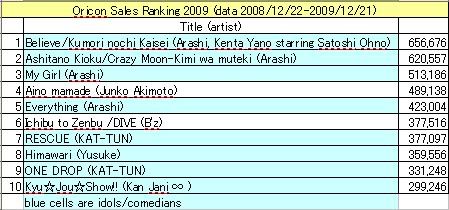
If you look at the singles sales ranking by Oricon, you can see that out of this year's top 10, 4 was by Arashi - "idols" of Johnny's Entertainment. KAT-TUN and Kan Jani ∞ are both Johnny's idols and Yusuke is originally a comedian. Where have the artists gone from the sales ranking...?
Photobucket

Let's look at the album sales ranking by Oricon.
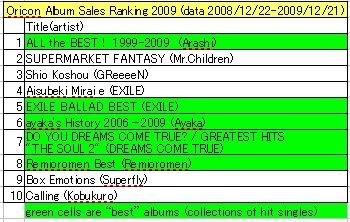
Photobucket

It looks like we have more "musicians" here, but the problem is that half of the top 10 selling albums are so-called "best albums" which is not a collection of new songs but a collection of old hit songs.

Karaoke ranking indicates that ALL of top 10 songs that were sung at Karaoke were music that were released before 2009.
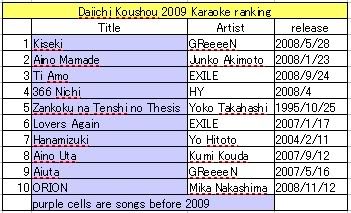
Photobucket

Another problem I see here is that even the best selling single CD this year sold only 656,676 pieces (please refer to the spreadsheet at the top).

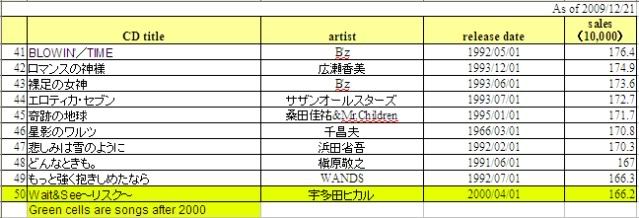
Following is the list of top 50 best selling singles and as you can see, most songs are released before 2000. With the exception of "Sekai de Hitotsu dake no Hana" by SMAP in 2003, all of the songs in the top 50 selling list are released on or before 2000.
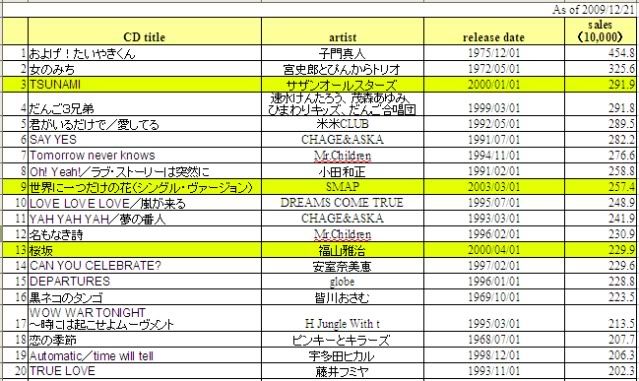
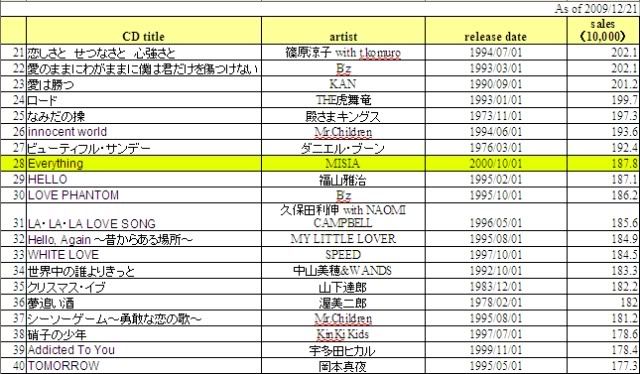
Photobucket

Photobucket

Photobucket

It is said that the taste of music has become varied compared to the past when everyone was listening to the same kind of music, and thus it is difficult to make mega hits.

** Music programs on TV shows **

One more thing I recognized about the music industry nowadays is that TV shows stopped featuring new songs and new artists- instead they are showing old rankings and old (and famous) musicians. In the past, there were TV programs like "Best10" and "Top10" which were featuring that weeks' best selling music, but those shows have disappeared. One of the music TV shows that survived- "Hey Hey Hey Music Champ" used to show newest music and artists a couple of years ago, but recently they started to focus on older music (they show ranking from older years, ranking with themes like Christmas songs or party songs or sad songs etc which end up showing older and famous songs). It's probably a chicken and egg problem- because they can get more people to watch the show by showing older songs than new ones, they started to focus on the older songs which would deprive new artists to be on TVs which (at least to me) seems to be creating a vicious cycle.

New artists are not seen in TVs and chances to be known by the audience decreased, therefore people don't buy new songs by new artists but buys stuff like "best albums" which is basically older songs and sings old and famous songs at karaokes.

But probably this logic applies only to the older generation which watches TVs, goes to karaoke and uses PC. Younger generation in Japan are said that they don't watch TVs, don't go to karaoke and use mobile phones.

It is said that younger people are not buying packages (except for the idol lovers who wants to show their love to the idols by purchasing their products) instead people are getting music by digital downloading, and many of them are using illegal music download / sharing system, also young people don't use PC but rather use mobile phones for their online activities.

** What kind of music young Japanese are listening to **

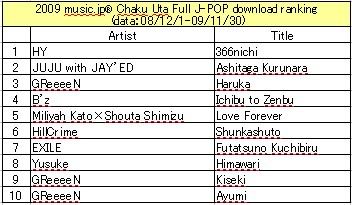
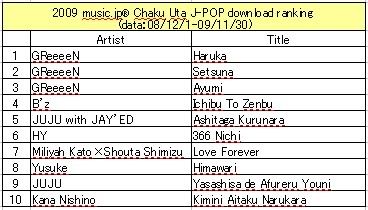
Let's look at data from Music.jp Chaku Uta (ringtone for mobile) Download ranking.
Photobucket

Photobucket

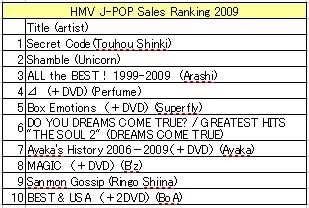
So these are the music that the younger people are listening to- and they do have new singers and songs like GReeeeN, JUJU and Kana Nishino. It's clearly different from what people are buying at HMV online sales ranking as follows:
Photobucket

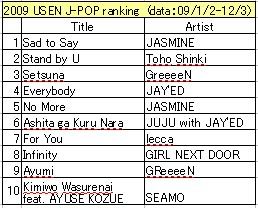
OH and one more important metrics is USEN (cable broadcast) request ranking. USEN usually pops up new artists that are not yet well known.
Photobucket

** Decline in music sales- in Japan and US **

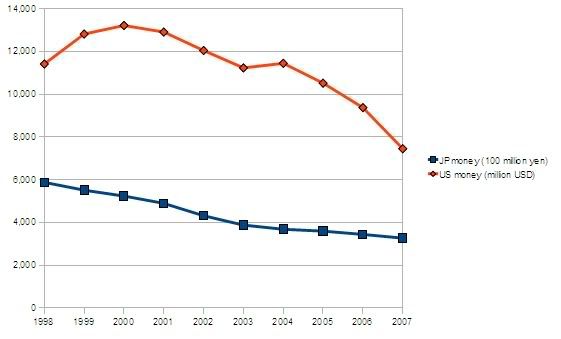
The decline in the sales amount and sales revenue is not only in Japan- it looks like the tendency is bigger in U.S.
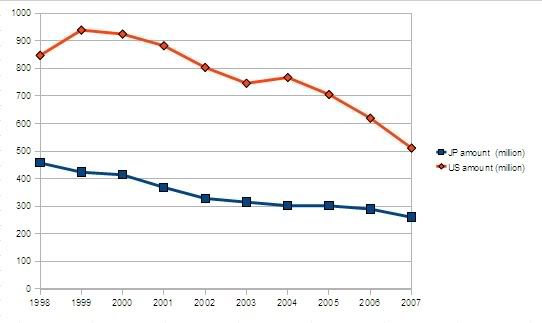
Photobucket

Photobucket

Data source (JP production amount JP production value US shipment amount US shipment value via Takerunba blog)

** New music business models in Japan **

There are various new ways to inform, promote and sell music in Japan although they all still look experimental and not scalable yet.

1) Utilization of video sharing sites, allowing fans to remix and increase fan base that would pay

One is via websites especially video sharing sites such as NicoNicoDouga and YouTube. Susumu Hirasawa, an artists talks at an interview with ASCII [ja]. He focuses on internet for his promotions / sales and is increasing sales recently despite the decline of the industry as a whole. He doesn't do any of the standard promotions that other musicians do- he doesn't visit publishing companies or broadcast stations to get exposure. "I'm not well-known but I get more CD sales, more fans comes to my live performances than other musicians. I get request for live performances from overseas and you can find my name even in Pharsi Wikipedia."

People gets to know his music via sites like NicoNicoDouga and starts to create remix music and video and uploads to NicoNicoDouga again- and he doesn't delete them. He lets his fans remix. His DVDs does not have copy protection because he knows the listeners would copy it anyways. He is one of the rare musicians who knows how to interact with his fans and at the same time make a business model there.

It is very similar to what is happening in Hatsune Miku and other Vocaloid series where artists who created music using Miku would distribute MP3 files for free, and lets people create remix music/videos, does not register their music to JASRAC even after major music label debut so that the fans can still use those music for remix because they know that the reason why they became successful is because the fans made remixes and made them famous. Even if the music is available for free, fans still buys the CDs when they see them because they want to support the creators and they know the artist will not gain any revenue from the free MP3s files and yet they are making them available. When the artists start to lock up their music or withdraw the free versions and start charging them, backlash happens. This phenomena is called "kencho" meaning hatred towards business makers.

2) Collaborate with mobile websites that the young people are using

Another interesting promotion example is how Kana Nishino's song was collaborating with Cell phone novels. As I wrote in this post, teenagers nowadays reads cell phone novels a lot. The novel and Nishino's song both had long-distance love as the theme and the song became a big hit among the youngsters.

3) Animations are a great touching point with large audience

I also think it is interesting that Japanese animations that are popular worldwide might take a role in music industry too. When I was visiting Chile, I met a university student that told me she is a big fan of a Japanese singer called Hyde. She (and her friends) would have never known about Hyde or his band L'arc en Ciel if their music was not used as a theme song of a popular animation, but because of that she is now a big fan of Hyde and buys all the CDs, goodies that she can find. She can sing songs of L'arc in Japanese, she translated and made Spanish versions too. She became interested in J-POP ever since, and told me that she is going to a concert of Dir en Grey -another Japanese band- as they are visiting San Tiago for a concert tour. Should we say this is just a rare example or should we say this is tip of iceberg and there is a big potential...?

** Lack of megahit will impact Japanese culture? **

I think the lack of mega hit might impact culture to some extent- people will not have a common song that they all know and can sing together after years.

Music has a power to bind people together- I was travelling in Bolivia a couple of months ago with strangers - Slovenians, Bolivians, German, Spanish and me(Japanese). The first thing that bound us all together was when we had "Billy Jean" by Michael Jackson as BGM on a car and everyone started singing. I think the songs in the top 50 list above are sort of like that for the Japanese. But with the current situation where there is less music being sold, there is a generation gap in what music people listens to... it would be difficult to have such experience.

** Hoping for better artists and music to appear- that will last for years **

Getting back to Oda-san, I think the way he invited artists aged twenties through sixties, creating a music together and performing together with them would be a great experience for the young artists as well as the viewers of that TV program, and I am so happy he's doing that, and I am hoping that there will be more new and wonderful songs that would be a favorite of lots of people and would last for years to come :)


Update on 2012/12/30

Unfortunately, it's getting worse.

Oricon yearly CD sales ranking, literally dominated by AKB and its sister groups (red cells, girls idol groups) and Johnny's entertainment groups (yellow cells, boys idol groups).


One thing to note about this ranking is the "bonus" part- most CDs are accompanied by "shake hand ticket" with the artists (girl idols). This may seem funny, but it's important for young boys- my niece who was a junior high school student was one of those boys who bought the ticket and happily went to Makuhari Messe for the first time in his life, to shake hands with those girls. I have heard that some people who wants to shake hands buys multiple CDs and throws them away.


The other aspect about this is they sell several versions of same CDs (as you can see in the types column, all of the top20 CDs has multiple version).

Update on 2016/12/27

Oricon yearly CD sales ranking, dominated again by AKB and its sister groups (yelllow cells, girls idol groups) and Johnny's entertainment groups (green cells, boys idol groups).

1位 : 翼はいらない AKB48 推定累積売上数:1,519,387
2位 :君はメロディー AKB48 推定累積売上数:1,294,962
3位 :LOVE TRIP/しあわせを分けなさい AKB48 推定累積売上数:1,213,660
4位 :ハイテンション AKB48 推定累積売上数:1,202,533
5位 :サヨナラの意味 乃木坂46 推定累積売上数:910,811
6位 :裸足でSummer 乃木坂46 推定累積売上数:851,229
7位 :I seek/Daylight 嵐 推定累積売上数:828,533
8位 :ハルジオンが咲く頃 乃木坂46 推定累積売上数:828,315
9位 :復活LOVE 嵐 推定累積売上数:541,121
10位 :Power of the Paradise 嵐 推定累積売上数:471,619
11位 :二人セゾン 欅坂46 推定累積売上数:467,845
12位 :世界に一つだけの花(シングル・ヴァージョン) SMAP 推定累積売上数:439,774
13位 :世界には愛しかない 欅坂46 推定累積売上数:392,719
14位 :サイレントマジョリティー 欅坂46 推定累積売上数:376,871
15位 :チキンLINE SKE48 推定累積売上数:365,328
16位 :僕はいない NMB48 推定累積売上数:363,583
17位 :最高かよ HKT48 推定累積売上数:332,231
18位 :金の愛、銀の愛 SKE48 推定累積売上数:324,415
19位 :真剣SUNSHINE Hey!Say!JUMP 推定累積売上数:308,610
20位 :74億分の1の君へ HKT48 推定累積売上数:305,137
21位 :罪と夏 関ジャニ∞ 推定累積売上数:300,357
22位 :甘噛み姫 NMB48 推定累積売上数:296,753
23位 :Sha la la☆Summer Time Kis-My-Ft2 推定累積売上数:291,356
24位 :Fantastic Time Hey!Say!JUMP 推定累積売上数:288,361
25位 :GravityKis-My-Ft2推定累積売上数:238,550